ATMI 2026 · Composition pedagogy & AI

Supporting the student’s compositional judgment.

How do students come to recognize, articulate, and evaluate what is musically meaningful—and how might structured AI dialogue support that development?

Dr. Tim Thompson · Virginia State UniversityDr. Ivan Elezovic · Jackson State University

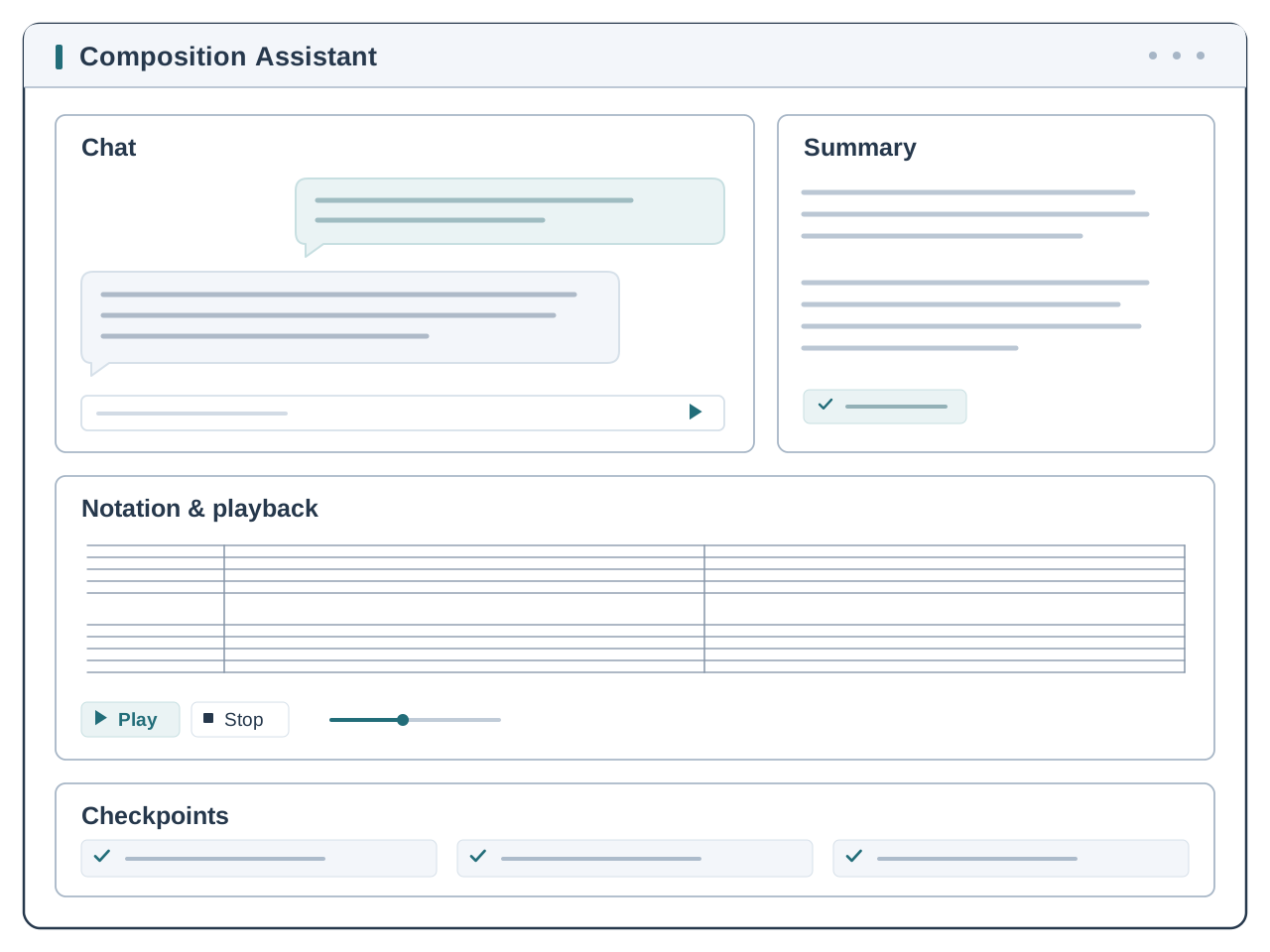
Labeled schematic of the Composition Assistant: Chat, Summary, empty staff lines with playback controls, and Checkpoints.

01 · The project

A framework for learning through musical decisions.

Composition Assistant is a pedagogical framework and accompanying web application for undergraduate composition instruction. Its central concern is how students come to recognize, articulate, and evaluate what is musically meaningful to them, and how structured interaction with AI might support that development. The student remains the composer and final artistic authority.

The framework organizes interaction around four stages: Initiation, clarifying intentions and establishing a workable direction; Exploration, investigating and comparing musical possibilities; Creation, developing and organizing the work; and Reflection, evaluating what the music has become and deciding what to retain, test, or revise. These stages provide a semester-level structure and recurring modes of working. Students may revisit them as their ideas develop. A separate Open Studio mode accommodates questions that span stages.

The application provides a private space for conversation about ideas, musical concepts, and work in progress. Students can upload MusicXML from their notation software, discuss the supplied passage, and request short notated examples or transformations. Examples can be viewed, heard through piano audition, revised conversationally, and downloaded for further work. The original uploaded score remains unchanged, and students continue composing in their own musical environment.

Compact working summaries support continuity, while optional checkpoints preserve selected snapshots. The proposed instructional process also incorporates progress reflections, which may be initiated by the student or assigned by an instructor. Students can review and choose what to share from their work. These records could help instructors understand students’ intentions, uncertainties, and reasons for musical decisions, informing subsequent lesson dialogue.

The current phase centers on faculty development and functional testing. Planned research will examine the contribution of the framework and application to student self-regulation, compositional judgment, and student–instructor interaction. Decisions about instructional milestones, submitted artifacts, evidence collection, and research procedures are still being developed. The project presents a pedagogical design and working application; it makes no claim yet about effects on student learning.

02 · Ways of working

Four stages, revisited as the work develops.

The stages organize a semester and provide recurring ways of working as ideas develop. Select a tab to explore its focus and possible questions.

What am I trying to create or investigate?

AI role

Clarify intentions, translate ideas into workable parameters, and suggest productive constraints.

Student role

State the artistic aims and choose a workable direction.

Possible starting questions

  • “Ask me questions to help clarify my intentions.”
  • “Help me identify a compositional question or focus.”
  • “Help me choose productive constraints, such as instrumentation, duration, or technical difficulty.”

03 · The application

Think, hear, compare, decide

The app supports conversation about an idea, a musical question, or work already in progress.

Labeled schematic of the Composition Assistant: Chat, Summary, empty staff lines with playback controls, and Checkpoints.
  • Conversation about intentions and choices

    Use ordinary musical language to clarify an idea, consider an alternative, or examine the consequences of a decision.

  • Notation that can be examined and heard

    Upload MusicXML, request a short example or transformation, hear a piano audition and revise conversationally. Download examples for further work in your own notation software.

  • Continuity and sharing

    Working summaries and optional checkpoints retain a compact account that students can review and share with an instructor.

A short technical outline
Conversation
OpenAI API, with centrally managed access and model choices.
Musical evidence
music21 extracts notation data and supports selected calculations.
Score display
Verovio renders MusicXML in the browser.
Audition
Web Audio with a sampled piano for pitch and rhythm.
Application
Django, PostgreSQL and Render hosting.

The app preserves the original score and sends selected conversation and score-derived data to OpenAI. Account holders have private projects and can share reviewed summaries with instructors.

What is musically meaningful?

A rationale for structured conversation, student agency and reflection throughout the compositional process.

Learning to compose involves developing a capacity to recognize, articulate, and evaluate what is musically meaningful. Students may struggle to identify an intention, explain what they hear in their work, or decide which possibilities deserve further attention. They may also frame decisions around anticipated instructor approval. Instructors, in turn, need to understand the student’s emerging purposes in order to offer meaningful guidance. The project addresses this reciprocal challenge: supporting students’ compositional judgment and helping them communicate that judgment within the teaching relationship.

Composition pedagogy offers several points of connection. Lupton and Bruce’s model brings together learning from other composers, developing technical mastery, exploring ideas, and developing an individual voice. These themes locate personal expression alongside the acquisition and use of musical knowledge. Lupton and Bruce (2010). In interviews with eight higher-education composition teachers, Lörch and Huovinen found that teachers described self-reflection as a means of helping students clarify musical intentions and aesthetic preferences. Their discussion also recognizes the sensitivity of intervening in personally meaningful creative work. This raises a question about how to support students actively while preserving their artistic freedom. Lörch and Huovinen (2025).

The four-stage framework proposes structured AI dialogue as an additional setting in which students can practice articulating intentions, considering alternatives, attending to musical consequences, and explaining decisions. Its aim is to support self-regulated learning: students increasingly setting their own goals, monitoring their work, and deciding what to do next. Questions and demonstrations are intended to help students develop criteria they can use independently. Visible notation and playback connect verbal discussion to material the student can examine and hear. Reflection can recur while a piece is developing, and an evolving intention or a decision to retain a passage can be a legitimate outcome.

The instructor-facing purpose is equally important. Barrett and Gromko’s case study describes composition teaching and learning through reciprocal dialogue, shared problem finding, and the exploration of possible solutions. Barrett and Gromko (2007). Student-reviewed summaries, selected exchanges, and reflective responses could provide additional starting points for such dialogue. When students choose to share these accounts, instructors may gain insight into concerns, intentions, and decisions that are difficult to infer from a score alone. The records would be interpreted as accounts of the student’s process, with attention to whether the words originated with the student, the AI, or subsequent editing.

The planned study will investigate whether this process supports students’ independent judgment and whether shared accounts help instructors respond more closely to students’ developing aims. It will also examine where AI guidance may confuse, steer, or oversimplify that process. These are research questions arising from the design; the current faculty-development phase does not establish learning outcomes or teaching effects.
05 · Examples

From dialogue to a reviewed account.

Passages from faculty testing.

01 · Initiation · Composer and AI

Finding an opening intention

Read the dialogue · 4 exchanges

Trombone and piano · Before drafting the opening.

The composer works toward a lyrical opening in which fragments lengthen and the spaces between them narrow, while the piano’s role remains open.

Composer

I have a friend who is a trombonist. He asked me to compose a piece for him. I can't decide if it should be trombone alone or with piano. He is a very good player. I'm not quite sure how to get going.

AI

A strong player gives you room to explore, but you don’t have to settle the instrumentation before finding the piece’s central curiosity. What do you most want to hear this trombonist do—sustain and shape a long line, move through agile or extreme-register writing, make unusual colors, or something else? And are you imagining an intimate solo statement, or a piece where another sound could challenge or support him? Those answers may help you decide whether piano feels essential or merely available.

Composer

I'm thinking about sustaining a long, lyrical melodic line. I want it to start not softly, but sort of unassuming, and gradually build in intensity to a climax before the next section starts, which could be more rhythmic.

AI

That gives you a clear dramatic arc: a lyrical line that begins with presence but without announcing itself, then gathers intensity toward a threshold before the rhythmic section. One useful choice is what makes the build perceptible—expanding range, longer or more forceful phrases, rising register, thicker piano support, or some combination. For the opening, does “unassuming” mean restrained dynamics, a plain or speech-like contour, or something else? And are you leaning toward piano as a partner in that build, or would you like the trombone to carry it alone?

Composer

Not forceful. But now that I think about it, it could start with shorter melodic fragments with space between them, and that gradually get longer as the spaces get shorter. That could lead into a more continous line. I think the piano would be a partner, maybe with soft but slightly crunchy chords at first.

AI

That sounds like a promising way to make the line grow without starting forcefully: fragments gradually lengthen, the silences narrow, and the trombone eventually sustains a more continuous phrase. Soft, slightly crunchy piano chords could give the opening a gentle tension without taking over. One useful choice to clarify is whether the piano’s chords should also become more active or intense as the trombone line fills out, or stay restrained so the trombone carries most of the build. Are you picturing the fragments as recognizable pieces of one developing melody, or more like separate gestures that gradually connect?

Composer

I think the latter, but maybe both. I'll go work on it and try to figure that out.

AI

That’s a useful place to pause: the fragments can begin as distinct gestures and gradually start to sound connected, if that feels right as you work. You can leave the piano’s role open for now, too. When you’re ready, we can pick up with how the fragments relate—or whichever question comes into focus.

02 · Creation · Composer and AI

Deciding what a downturn can do

Read the exchange

The same trombone-and-piano piece · An uploaded passage, measures 1–11.

A question about melodic direction becomes a choice about whether the end of the passage should feel like a close or a launch point for the next climb.

Composer

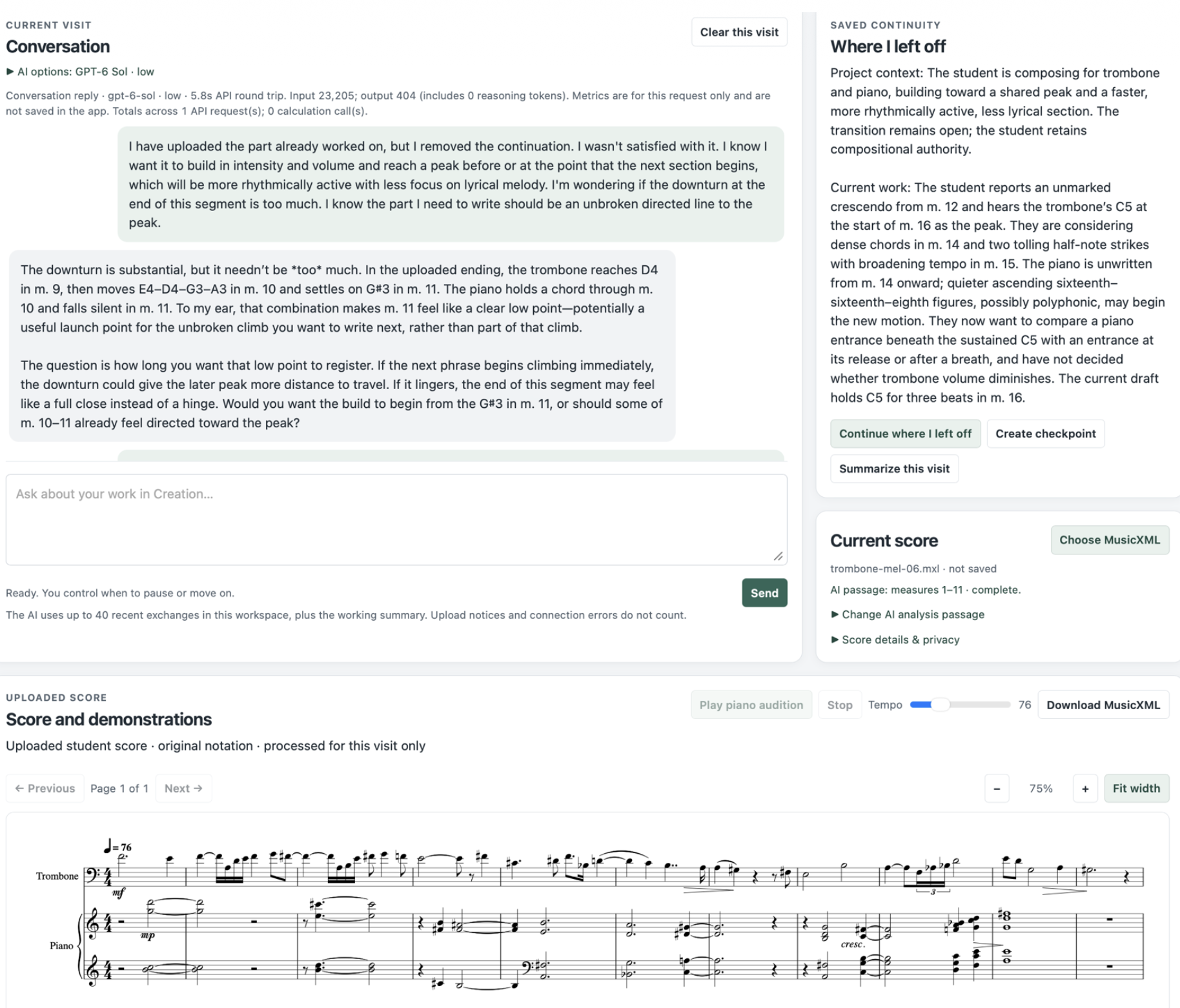
I have uploaded the part already worked on, but I removed the continuation. I wasn't satisfied with it. I know I want it to build in intensity and volume and reach a peak before or at the point that the next section begins, which will be more rhythmically active with less focus on lyrical melody. I'm wondering if the downturn at the end of this segment is too much. I know the part I need to write should be an unbroken directed line to the peak.

AI

The downturn is substantial, but it needn't be too much. In the uploaded ending, the trombone reaches D4 in m. 9, then moves E4-D4-G3-A3 in m. 10 and settles on G#3 in m. 11. The piano holds a chord through m. 10 and falls silent in m. 11. To my ear, that combination makes m. 11 feel like a clear low point—potentially a useful launch point for the unbroken climb you want to write next, rather than part of that climb. The question is how long you want that low point to register. If the next phrase begins climbing immediately, the downturn could give the later peak more distance to travel. If it lingers, the end of this segment may feel like a full close instead of a hinge. Would you want the build to begin from the G#3 in m. 11, or should some of m. 10-11 already feel directed toward the peak?

Conversation, continuity summary and the uploaded trombone-and-piano score.Enlarge screenshot ↗
The conversation, saved continuity and uploaded score appear together in the app.

03 · Creation · Composer and AI

Trying a revision and checking a pitch-class relationship

Read the preparation, edits and analysis

The same piece · An editable copy of measures 8–11.

The composer requests precise note changes, then asks about the relationship between the revised melody and a sustained piano chord. The example is revised while the uploaded score is retained.

AI

I've loaded the last four measures of the current upload (mm. 8-11) as an editable example, with the trombone and both piano staves. This is the unchanged starting excerpt; we can make the screenshot edit one step at a time. The uploaded score remains unchanged.

Composer

In the trombone part in m. 10, leave the first two eighth notes, then for beats 2, 3, and 4, create quarter notes B3-C4-D4.

AI

I've made that change in the editable example: m. 10 now has E4-D4 as eighth notes, followed by B3-C4-D4 as quarter notes. The piano and m. 11 remain unchanged; the uploaded score is untouched.

Composer

For m. 11, change the note to C#4.

AI

Changed the trombone's three-beat note in m. 11 to C#4 in the editable example. The final rest and piano are unchanged.

Composer

Is the pc set class created by the trombone notes in m. 10(0135) an abstract subset of the piano chord in m. 10 with either T or TI operations?

AI

Yes-in the editable example, the trombone's m. 10 pitches E-D-B-C-D give the four-note set {C, D, E, B}, prime form (0135). Taking the piano chord across both staves as {A, D, E, F#, G}, it is an abstract subset under T6l, but not under any transposition alone. T6l maps the trombone set to {F#, E, D, G}, all contained in the piano chord; A is the extra pitch. This describes a set relationship, not a literal simultaneous doubling-the trombone notes unfold against the sustained chord.

04 · Creation · Composer and AI

Clarifying where the peak belongs

Read the selected passage

The same piece · A selected exchange from a later visit.

The composer identifies the trombone’s C as the peak and describes how a quieter piano entrance could begin the next texture.

AI

Yes-that could make the broadening feel like gathering weight, not losing energy. Two attacks of the same dense chord in m. 15 could toll like a bell: the second strike renews the sound while the tempo stretches. Then the piano's silence on the downbeat of m. 16 leaves space around the trombone's C5 before the sixteenth-note current enters mid-measure and establishes the faster tempo. That suggests a useful distinction: the shared peak might be the second chord strike in m. 15, with C5 as its exposed continuation—or the delayed piano entrance could be the peak's final surge. Which moment do you want to feel most forceful? The transition may also be easier to hear if the new piano rhythm makes the faster pulse unmistakable on its first entrance.

Composer

I'm hearing the C as the peak. I'm thinking it will work best if the piano doesn't wait long-like if there is a tenuto on beat one, by beat two the piano has begun new material, which would start somewhat quieter and thinner with a series of 16-16-8 ascending scale figures, maybe a little polyphonic. That would lead into a busier texture. The trombone would enter with new material within a couple of measures.

05 · Initiation · AI-generated visit summary

Carrying intentions and open questions forward

Read the complete visit summary

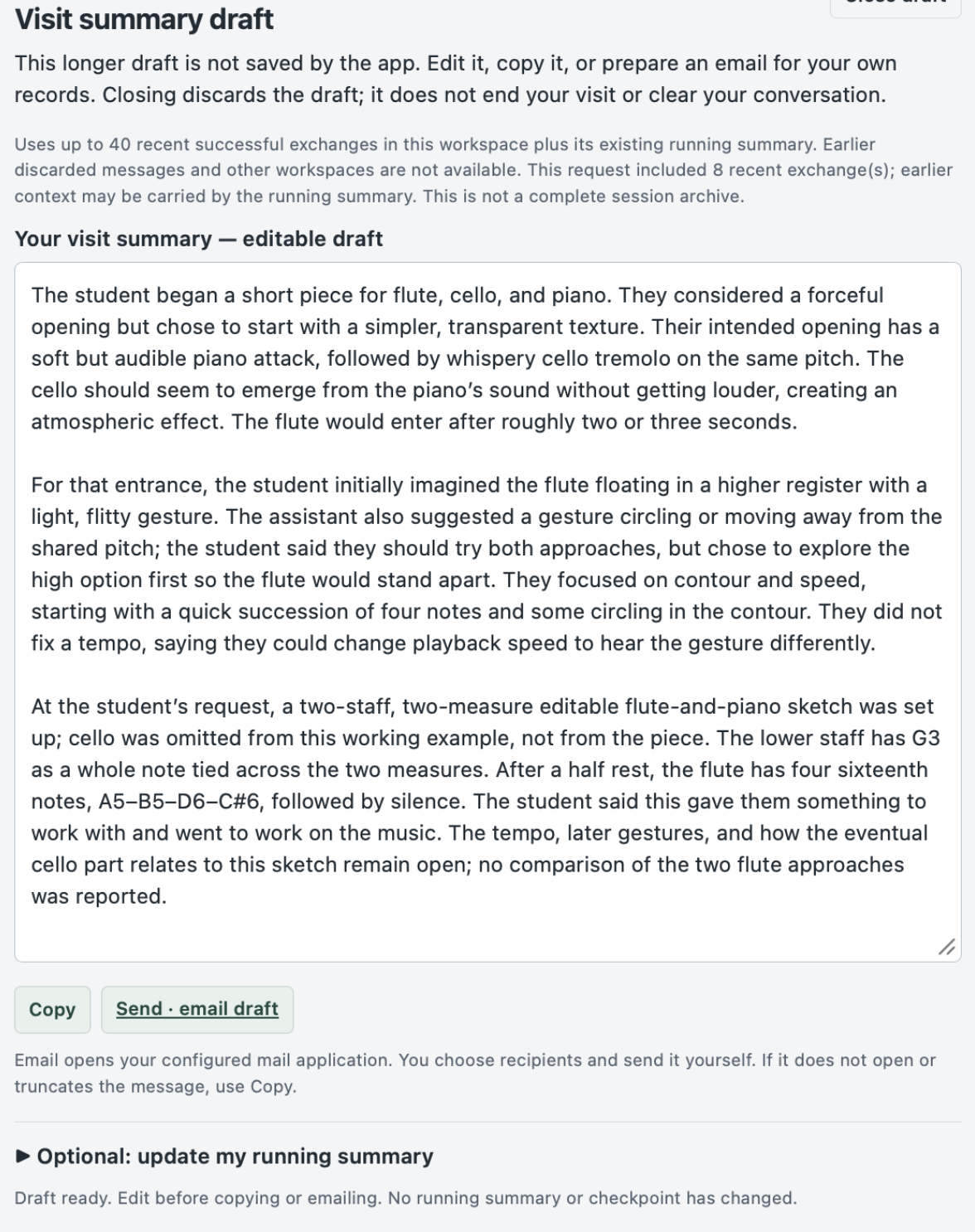
A different piece · Flute, cello and piano.

The summary gathers the opening concept, options considered, the composer’s choices and the questions still open after a short notation experiment.

AI-generated summary

The student began a short piece for flute, cello, and piano. They considered a forceful opening but chose to start with a simpler, transparent texture. Their intended opening has a soft but audible piano attack, followed by whispery cello tremolo on the same pitch. The cello should seem to emerge from the piano's sound without getting louder, creating an atmospheric effect. The flute would enter after roughly two or three seconds.

For that entrance, the student initially imagined the flute floating in a higher register with a light, flitty gesture. The assistant also suggested a gesture circling or moving away from the shared pitch; the student said they should try both approaches, but chose to explore the high option first so the flute would stand apart. They focused on contour and speed, starting with a quick succession of four notes and some circling in the contour. They did not fix a tempo, saying they could change playback speed to hear the gesture differently.

At the student's request, a two-staff, two-measure editable flute-and-piano sketch was set up; cello was omitted from this working example, not from the piece. The lower staff has G3 as a whole note tied across the two measures. After a half rest, the flute has four sixteenth notes, A5-B5-D6-C#6, followed by silence. The student said this gave them something to work with and went to work on the music. The tempo, later gestures, and how the eventual cello part relates to this sketch remain open; no comparison of the two flute approaches was reported.

Editable visit summary describing an atmospheric opening for flute, cello and piano.Enlarge screenshot ↗
A visit summary is an editable draft that the composer can copy or prepare for email.

06 · Open Studio · Prepared questions and composer responses

Reflecting on progress in the composer’s own words

Read all three questions and responses

Another piece · Piano writing · Local development preview.

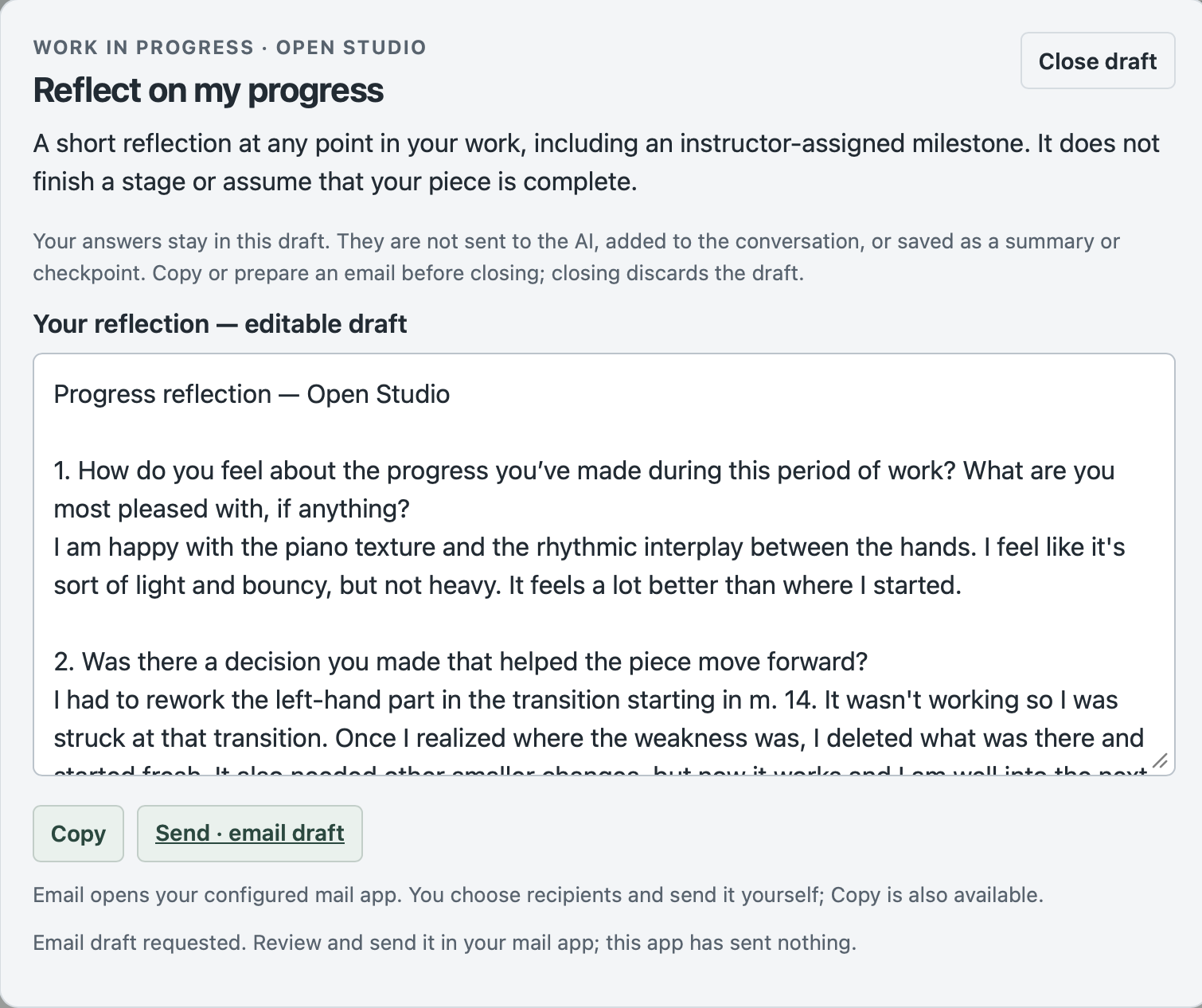
Three prepared questions invite an account of progress, a helpful decision and what remains difficult. The composer’s responses stay distinct from AI-generated summaries.

Prepared question

How do you feel about the progress you’ve made during this period of work? What are you most pleased with, if anything?

Composer

I am happy with the piano texture and the rhythmic interplay between the hands. I feel like it's sort of light and bouncy, but not heavy. It feels a lot better than where I started.

Prepared question

Was there a decision you made that helped the piece move forward?

Composer

I had to rework the left-hand part in the transition starting in m. 14. It wasn't working so I was stuck at that transition. Once I realized where the weakness was, I deleted what was there and started fresh. It also needed other smaller changes, but now it works and I am well into the next section.

Prepared question

What feels unresolved, frustrating, or difficult to continue? What might help you move forward?

Composer

I'm really not sure how I want to end it. I'm thinking through options, and hope it will come to me when I get there.

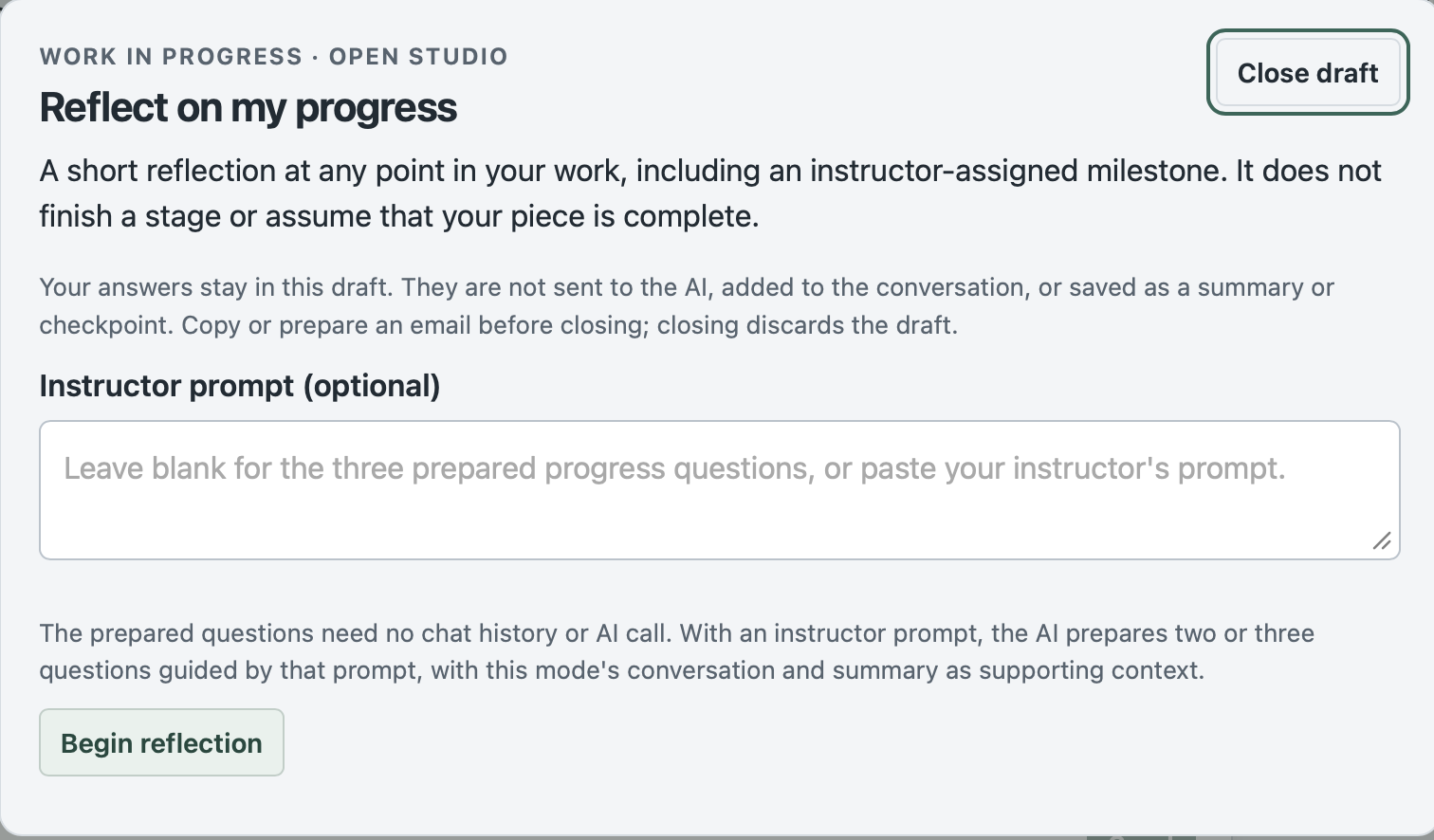
Progress reflection prompt with an optional instructor prompt and a Begin reflection button.Enlarge screenshot ↗
The prepared questions can be used without chat history; an instructor can supply a different focus.
Editable progress reflection with the composer’s responses and Copy and email-draft controls.Enlarge screenshot ↗
The editable reflection draft. All three responses are included in the transcript.

06 · Supporting literature

Bibliography

The bibliography spans composition pedagogy, creative processes and human–AI interaction.

24 references

  1. 01
    Amershi, Saleema, et al. “Guidelines for Human-AI Interaction.” In Proceedings of the 2019 CHI Conference on Human Factors in Computing Systems. 2019. .
    Source link ↗
  2. 02
    Babbitt, Milton. “‘Teaching’ Composition at Princeton.” Contemporary Music Review 31, no. 4 (2012): 323–29.
  3. 03
    Barrett, Margaret S. “Creative Collaboration: An Eminence Study of Teaching and Learning in Music Composition.” Psychology of Music 34, no. 2 (2006): 195–218.
  4. 04
    Barrett, Margaret S. “Pedagogies of Creativity in Music: Facilitators and Constraints in Music Composition Teaching.” In The Oxford Handbook of the Creative Process in Music. Oxford University Press, 2021.
  5. 05
    Barrett, Margaret S., and Joyce E. Gromko. “Provoking the Muse: A Case Study of Teaching and Learning in Music Composition.” Psychology of Music 35, no. 2 (2007): 213–30.
  6. 06
    Berkley, Rebecca. “Teaching Composing as Creative Problem Solving: Conceptualising Composing Pedagogy.” British Journal of Music Education 21, no. 3 (2004): 239–63.
  7. 07
    Bunting, Roger. “Composing Music: Case Studies in the Teaching and Learning Process.” British Journal of Music Education 5, no. 3 (1988): 269–310.
  8. 08
    Burnard, Pamela, and Betty Anne Younker. “Mapping Pathways: Fostering Creativity in Composition.” Music Education Research 4, no. 2 (2002): 245–61.
  9. 09
    Cohen, Louis, Lawrence Manion, and Keith Morrison. Research Methods in Education. 8th ed. Routledge, 2018.
  10. 10
    Cope, David. Computer Models of Musical Creativity. MIT Press, 2005.
  11. 11
    Cope, David. Experiments in Musical Intelligence. A-R Editions, 1996.
  12. 12
    Cuthbert, Michael Scott, and Christopher Ariza. “music21: A Toolkit for Computer-Aided Musicology and Symbolic Music Data.” In Proceedings of the 11th International Society for Music Information Retrieval Conference, 637–42. 2010.
  13. 13
    Ericsson, K. Anders, and Herbert A. Simon. Protocol Analysis: Verbal Reports as Data. Rev. ed. MIT Press, 1993.
  14. 14
    Finke, Ronald A., Thomas B. Ward, and Steven M. Smith. Creative Cognition: Theory, Research, and Applications. MIT Press, 1992.
  15. 15
    Iversen, Kristian T. “Impacts of Artificial Intelligence in Music Education: A Scoping Review of Instructional Strategies and Student Learning Outcomes.” International Journal of Music Education (2026). .
    Source link ↗
  16. 16
    Lörch, Lucas, and Erkki Huovinen. “Fostering Composer Voice in Tertiary Teaching of Contemporary Music Composition.” Journal of Research in Music Education 73, no. 1 (2025): 87–108. .
    Source link ↗
  17. 17
    Lubart, Todd. “How Can Computers Be Partners in the Creative Process: Classification and Commentary on the Special Issue.” International Journal of Human-Computer Studies 63, nos. 4–5 (2005): 365–69.
  18. 18
    Lupton, Mandy, and Christine Bruce. “Craft, Process and Art: Teaching and Learning Music Composition in Higher Education.” British Journal of Music Education 27, no. 3 (2010): 271–87.
  19. 19
    Medeiros, K., D. H. Cropley, R. L. Marrone, and R. Reiter-Palmon. “Human-AI Co-Creativity: Does ChatGPT Make Us More Creative?” The Journal of Creative Behavior (2025). .
    Source link ↗
  20. 20
    Pearce, Marcus, and Geraint A. Wiggins. “Aspects of a Cognitive Theory of Creativity in Musical Composition.” In Proceedings of the European Conference on Artificial Intelligence. 2002.
  21. 21
    Shneiderman, Ben. Human-Centered AI. Oxford University Press, 2022.
  22. 22
    Simon, Gregory. “Assessment and Frameworks in Collegiate Composition Studios.” In The Oxford Handbook Topics in Music. Oxford University Press, 2015. https://doi.org/10.1093/oxfordhb/9780199935321.013.102.
    Source link ↗
  23. 23
    Ward, Thomas B., Steven M. Smith, and Ronald A. Finke. “Creative Cognition.” In Handbook of Creativity, edited by Robert J. Sternberg. Cambridge University Press, 1999.
  24. 24
    Webster, Peter R. “Refining and Expanding Music Composition Pedagogies.” In The Oxford Handbook of Music Composition Pedagogy, 46–68. Oxford University Press, 2024.

07 · Next steps

A study of learning and teaching, in preparation.

The planned study concerns composition students and teachers. It will investigate how the framework and app relate to students’ compositional judgment and to the dialogue around their work.

Questions guiding development

  • How might structured AI interaction support students in clarifying intentions, evaluating choices and directing their own work?
  • How might student-reviewed accounts of that process inform an instructor’s understanding and response?
  • Where might AI guidance confuse, steer or oversimplify the process?

Decisions still being developed

  • When reflection is assigned and how milestones are used.
  • Which artifacts students and teachers would contribute.
  • How sharing, consent, evidence collection and analysis would work.

Participant recruitment is not yet open.Participation arrangements and recruitment materials are being developed. Details will be added when recruitment is ready to open.

For questions about the project or possible research collaboration, contact the authors.

Open full-size image ↗